

Meg March
Little Women


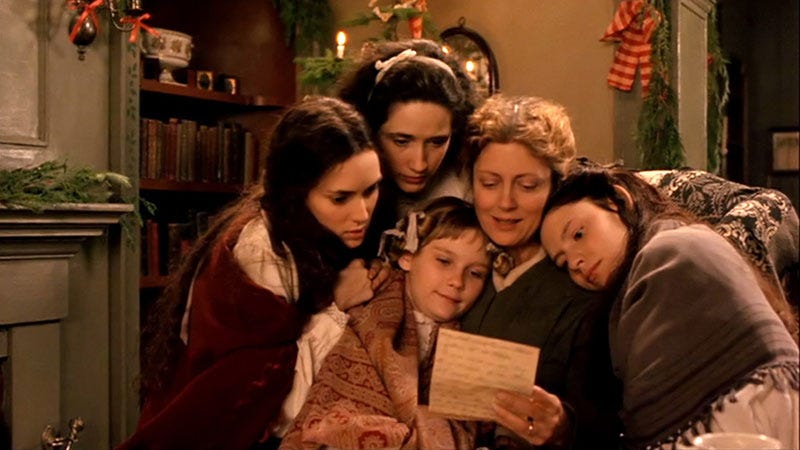
Little Women is one of the most beautiful books about womanhood ever written. Louisa May Alcott explores the many facets of femininity through her myriad of female characters.
Marmee is patient and compassionate, with a tender, loving motherliness; Meg is the organised eldest daughter and a hopeless romantic; Jo has a creative mind that never seems to rest; quiet little Beth puts everyone at peace; and Amy, the youngest sister, is an ambitious dreamer. Personally, I can find myself in all five of those women, which is what makes Alcott’s book so special to me. I strive to be like Marmee, I find myself drawn to Meg, knowing the responsibilities of an eldest daughter and the longing for marriage and motherhood. At the same time I dream of publishing my writings like Jo. I want to be successful and artistic like Amy, and I long to have Beth’s stillness and wisdom in a tumultuous world.
In this series I will take a deep dive into these ‘Little Women’, starting with Meg.
The eldest of the March sisters is often overlooked and undervalued as a character. Her other sisters usually demand all the attention both in the book and film adaptations. Meg is left behind as a silly young girl that then goes and gets married and the rest of her life is so uninteresting that it is not really worth mentioning.
In many ways that is how marriage and motherhood is viewed in today’s society. If you choose to fully embrace your role as spouse and mother, you are automatically assumed to be boring and you then fall into obscurity. Domesticity is seen as suppressive to a woman’s intellect, skills, and potential. Meg’s character demonstrates to us that quite the opposite is true. A frivolous girl in the beginning, she transforms into a strong and mature woman through her marriage and motherhood.
Meg is introduced to us as a pretty girl of sixteen. Her beauty is one of her chief attributes and she is often described as the ‘pretty one’. Aware of her beauty, Meg cares a lot about her looks and she likes to keep up to date with the modern fashions. Even though she can’t afford the luxuries of life, she at least likes looking at them and discussing them, mostly with her sister Amy.
Seeing her friends live in superfluity and idleness makes Meg resent her circumstances. Despite their mother’s encouragement to be well-rounded girls that engage in meaningful activities, Meg longs for comfort.
At the beginning of the book when the children share their dreams for the future, Meg describes her castle in the air as the following:
“I should like a lovely house, full of all sorts of luxurious things—nice food, pretty clothes, handsome furniture, pleasant people, and heaps of money. I am to be mistress of it, and manage it as I like, with plenty of servants, so I never need work a bit. How I should enjoy it! For I wouldn’t be idle, but do good, and make everyone love me dearly.”
Meg’s resentment for the hard work their mother emphasises as important and the reader recognises as character building is magnified by her concern for her hands. She wants lovely, soft, white hands, but because she has to do housework, her hands are not as soft and beautiful as she would like them to be. In her defense, however, Meg as the oldest did remember a time before the Civil War when her parents had more money and could afford to live with ease and pleasure.
The debut of Meg into the world of the rich with which she is so enamoured comes swiftly as her friend Sallie Gardiner invites her to a ball. Conscious of her circumstances, she wants to fit in with the other girls but is worried about not having a silk dress and wearing soiled, old gloves. It does not help when Jo burns some of her hair and she is incredibly upset.
Once they arrive at the ball though, Meg is in her element, dancing and socialising. Yet her vanity shows again when Jo mentions to Laurie that she is not allowed to dance as Meg fears her scorched dress might attract negative attention. Despite Jo’s mishaps and spraining her ankle, Meg manages to befriend Annie Moffat who invites her on a two week long trip to attend the opera and cotillions.
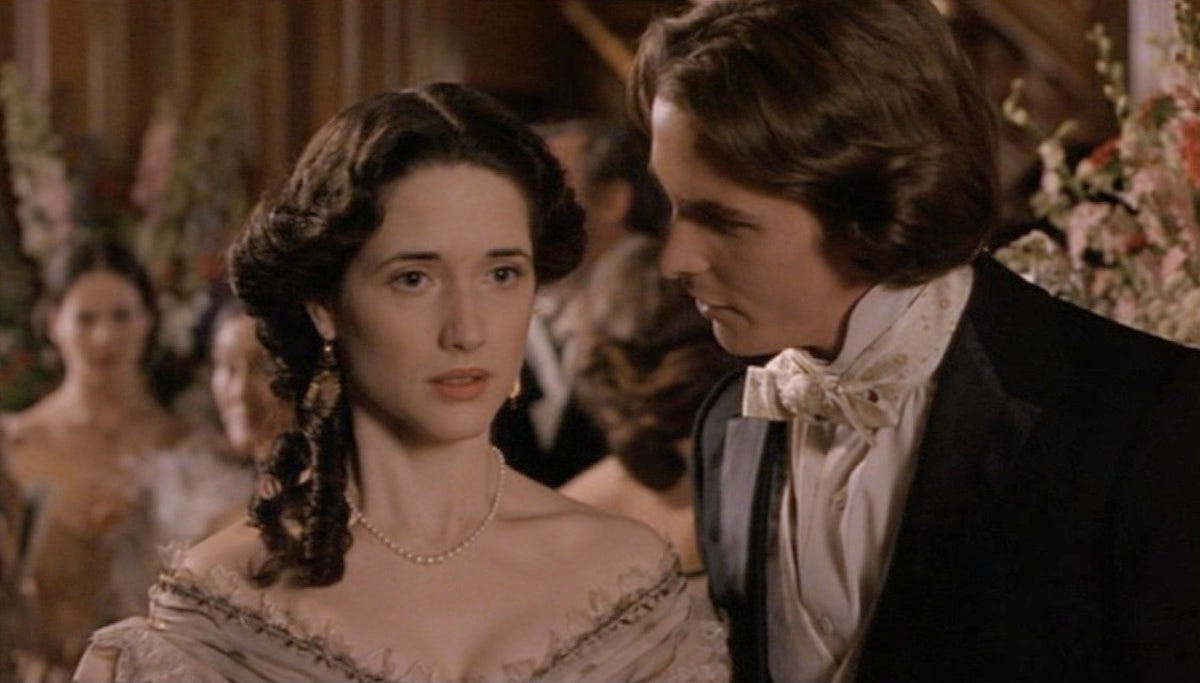
Meg is enthralled and after some begging, her mother reluctantly agrees to let her go. As she packs for her trip, Meg’s vanity mixes with her sweet nature as she realises “I won’t be so silly, or hurt Marmee’s feelings, when she took so much pains to get my things. It’s a nonsensical notion of mine, and I’m not going to give up to it. [...] I feel so rich and sort of elegant, with two new pairs, and the old ones cleaned up for common.” This resolution does show that Meg can appreciate her family's new position, especially her mother’s sacrifices within it.
When she arrives at the Moffatts’, we begin to realise the impact her parents have had on her. Despite being intimidated by the Moffatts’ wealth, "Meg felt, without understanding why, that they were not particularly cultivated or intelligent people, and that all their gilding could not quite conceal the ordinary material of which they were made.” Still, the prosperity all around Meg quickly subsumes her, and what her mother feared would happen comes to pass:
“The more she saw of Annie Moffat’s pretty things, the more she envied her and sighed to be rich. Home now looked bare and dismal as she thought of it, work grew harder than ever, and she felt that she was a very destitute and much-injured girl, in spite of the new gloves and silk stockings.”
She feels pitied when the girls see her in her old, shabby dresses and the only thing that cheers her up is Laurie’s flowers. But when she overhears Mrs Moffatt talking about her ‘dowdy tartalon’ and a conspiracy that she is out to marry Laurie for his money, Meg becomes disillusioned.
When she is then dressed up in someone else's dress and made up with lended jewellery and riches she at first feels beautiful and confident but on encountering Laurie she is shocked by his reaction.
“I shall say I didn’t know you, for you look so grown-up and unlike yourself, I’m quite afraid of you,” he starts before he continues to say that he does not like her appearance and the ‘fuss and feathers’.
After an argument she acknowledges: “I’m not Meg tonight, I’m ‘a doll’ who does all sorts of crazy things. Tomorrow I shall put away my ‘fuss and feathers’ and be desperately good again.”
Meg then feels ill and quickly leaves for home. There she confesses to a worried Marmee and an excited Jo, that she drank, gossiped and flirted. Marmee scolds her gently and admits that it was unwise to send her to such ‘worldly and ill-bred’ people with vulgar ideas while Meg turns herself back into her mother’s care, acknowledging,
“I know I’m a silly little girl, and I’ll stay with you till I’m fit to take care of myself.”
Marmee encourages her and shares her vision of her daughters with her: “I’d rather see you poor men’s wives, if you were happy, beloved, contented, than queens on thrones, without self-respect and peace.”
From then on out a change comes over Meg. She still likes fashion and on occasion seems to yearn for comfort and pretty things, but overall she becomes more mature. Meg’s character grows during her mother’s absences and she becomes a good housekeeper as well as a nurse for her sister Beth. The illness makes her reflect on the true treasures in life:
“Then it was that Margaret, sitting alone with tears dropping often on her work, felt how rich she had been in things more precious than any luxuries money could buy—in love, protection, peace, and health, the real blessings of life.”
When her father returns he is astonished by the beautiful young women in front of him. Giving each of them praises for their hard work, Mr March summarises Meg’s journey from spoiled girl to mature woman most beautifully using once more the symbolism of her hands:
“I remember a time when this hand was white and smooth, and your first care was to keep it so. It was very pretty then, but to me it is much prettier now, for in these seeming blemishes I read a little history. A burnt offering has been made to vanity, this hardened palm has earned something better than blisters, and I’m sure the sewing done by these pricked fingers will last a long time, so much good will went into the stitches. Meg, my dear, I value the womanly skill which keeps home happy more than white hands or fashionable accomplishments. I'm proud to shake this good, industrious little hand […].”
With these great change in Meg, we can see her move into the next beautiful stage in her life as the young bride of John Brooke.
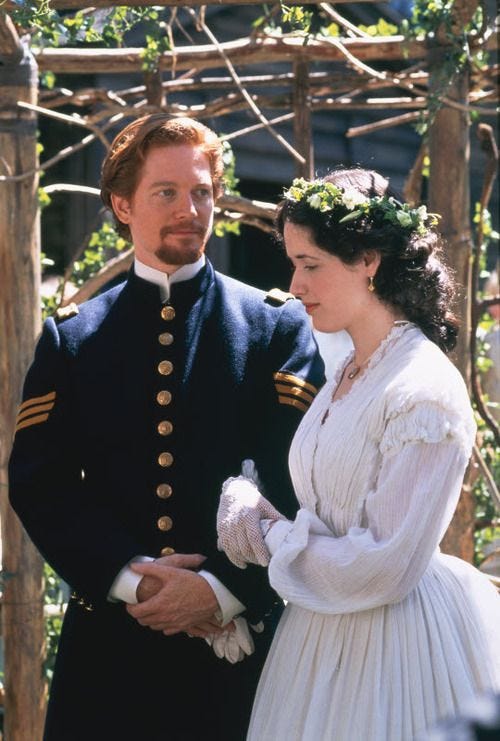
At first, Meg is still sad about her friend Sallie marrying rich and getting a grand house. However, seeing John’s labour of love to earn enough money to marry her and provide for her, she quickly realises that happiness and fulfillment don’t just come from money. His devotion to her is the greatest prize Meg could have asked for. This is why on her wedding day “Meg looked very like a rose herself, for all that was best and sweetest in heart and soul seemed to bloom into her face that day, making it fair and tender, with a charm more beautiful than beauty.”
Meg doesn't need ornaments and fancy dresses anymore. She is content with a small family wedding, flowers in her hair, and her deep love for her bridegroom.
Her parents best sum up this new chapter in life:
“Meg and John begin humbly, but I have a feeling that there will be quite as much happiness in the little house as in the big one. It’s a great mistake for young girls like Meg to leave themselves nothing to do but dress, give orders, and gossip.”
And in her eagerness to be a good wife, Meg truly does not have time to gossip and do nothing. For a while at least, the little woman budgets prudently and is proud of the nice, little home she keeps. However, as she renews her friendship with Sallie Gardiner (now married to Ned Moffatt), old wounds open up once more.
Seeing her wealthy home and all of the extravagances Sallie can allow herself to enjoy, Meg begins again to struggle with the little she and John have. It is an honest assessment of the experience of many young wives who go into marriage with great aspirations. Starting with little is difficult, but the beauty, as Meg discovers, is that it moulds a couple together and their marriage will only grow stronger because of it.
When Meg goes and spends too much money on silk for a dress she wants to make, John at first is upset and angry. Meg herself becomes upset when John says he now can’t afford a winter coat, but eventually they come together and truly connect:
“They had a long talk that night and Meg learned to love her husband better for his poverty, because it seemed to have made a man of him, given him the strength and courage to fight his own way, and taught him a tender patience with which to bear and comfort the natural longings and failures of those he loved.”
This in turn encourages Meg to put away her pride and vanity and go to her friend to sell her the silk. She orders John a winter coat, who is incredibly proud of his little wife and they reconcile, knowing that together they have achieved a milestone in their relationship. Meg is truly growing up and learning to make sacrifices out of love.
The woman that Meg becomes still likes to take care of herself and dress well on occasion, but she knows that her true beauty comes from the inside. Her nurturing and caring personality endears her to all and she learns that money is for the security of her family and not for superficial spending. Her development reminds me of the Proverbs 31 woman:
She sets about her work vigorously; her arms are strong for her tasks.
She sees that her trading is profitable, and her lamp does not go out at night.
In her hand she holds the distaff and grasps the spindle with her fingers.
She opens her arms to the poor and extends her hands to the needy.
We all strive to be good and to complete our tasks diligently. Meg’s story is a lovely reminder that none of us are perfect and we aren’t meant to be. We all have our vanities and we should endeavour to overcome them, but we shouldn’t let them hold us back. When Meg buys the expensive fabric and gets in an argument, she doesn’t give up. She becomes economical, trades it, and ensures that ‘she has no fear of winter for her household, for everyone has warm clothes.’ No one starts out being the best wife and mother, but what Meg demonstrates so well for us is that we should aim to thrive in adversity. Hard times are sure to come and we shouldn’t give up when they do. Rather, we need to examine our priorities and decide what truly matters.
Very interesting insight. I also find Meg March is so similar and yet different from Rosamund Vincy from ‘Middlemarch’. Both women have great aspirations for themselves and their husbands but while Meg, though an idealist, embraces her calling as a wife of a poor-ish man, Rosamund struggles with her choice and is miserable in her marriage, which causes herself and her husband great financial strain and of course unhappiness in their relationship; whereas Meg is a great example of how to adapt to circumstance and prioritises happiness in her marriage and the spiritual and emotional wellbeing of her family!