

Beth March
Little Women

NOTE: This article contains spoilers! If you haven’t read Little Women yet, I suggest getting this beautiful copy from Chiltern Publishing, which I use for my references in this article, https://www.chilternpublishing.co.uk/shop/classics/little-women/, along with the matching second volume of the story, Good Wives, https://www.chilternpublishing.co.uk/shop/classics/goodwives/. Happy reading!
Little Women holds a very special place in my heart; it was the first book I distinctly remember that elicited an emotional response from me as a young reader. It was the first story that made me fall in love with the characters as if they were my own sisters and friends. I rejoiced with the characters’ triumphs and mourned when they suffered tragedy, loss, and heartbreak. As far as I can recall, Little Women was the first book that made me cry. I read this book at the exact right time in my life; I was no older than eleven or twelve, and my interest in literature was really starting to intensify at this time. My first reading of it impacted me profoundly, and I credit Little Women as the book that inspired my desire to study literature at university.
Though I didn’t have the language to express this idea at the time, I know now that my first reading of Little Women was so formative because it made me realise that books do not simply tell stories. Rather, it is through these stories that literature examines the complexities of relationships between siblings, parents and their children, friends, and lovers. It asks questions about human nature; it examines problems of good and evil; it seeks truth. The best books are the ones that reveal glimpses of what philosophy and theology call the transcendentals: the good, the true, and the beautiful. Truly worthwhile works of art, music, drama, and literature contain elements of these transcendentals, and they necessarily point us toward God since God Himself is the true essence of the good, the true, and the beautiful. Little Women was the book that helped me to recognise the power of literature to reveal these things, and in my opinion, the character of Beth is at the very centre of this idea. While she is arguably the most overlooked March sister, Beth is the glue that holds the March family together because of her inspiring virtue. Beth is the one who helps her sisters see goodness, beauty, and truth in the mundane monotonies of life, even when she sometimes fails to recognize them in herself.
From the very beginning of the novel, Beth clearly tries to see the good in every situation, even when her sisters cannot. The book opens with the March sisters complaining about their lack of Christmas presents because of their family’s economic situation. In the very first line of the book, Jo says, “‘Christmas won’t be Christmas without any presents”,1 to which Meg and Amy respond similarly. Beth, on the other hand, offers a different outlook. She quietly says, “‘We’ve got Father and Mother, and each other”.2 The dialogue tag even comments that she says this contentedly; Beth isn’t bothered by the lack of presents, but rather chooses to see the good in their lack. This is a pattern throughout the book; Beth continually provides a quiet optimism and hope to which her sisters seem blind until Beth reveals it to them.
Not only does Beth try to help her sisters see the good in every situation, but she also helps them to see the good in themselves. Early in the book, she compliments Jo on her writing abilities when she says, “‘I don’t see how you can write and act such splendid things, Jo. You’re a regular Shakespeare!’”.3 Beth sees how talented of a writer her sister is and does not hesitate to affirm her in her talent and love for literature. A little later in the novel, she admires how Meg diligently reads from the book their mother gave them for Christmas, and says to Amy, “‘How good Meg is! Come, Amy, let’s do as they do. I’ll help you with the hard words, and they’ll explain things if we don’t understand’”.4 Beth not only sees the good example of her older sister, but she also doesn’t hesitate to model her sister’s behaviour and encourages her younger sister to do the same. Beth seems to have a natural tendency toward the good and desires to cultivate it within herself. Equally as important, however, is that Beth wants Amy to share in the goodness of Meg’s example too; though this is a seemingly small exchange, Beth’s encouragement of Amy to follow in Meg’s example alongside her is a beautiful example that goodness is meant to be shared with those around you.
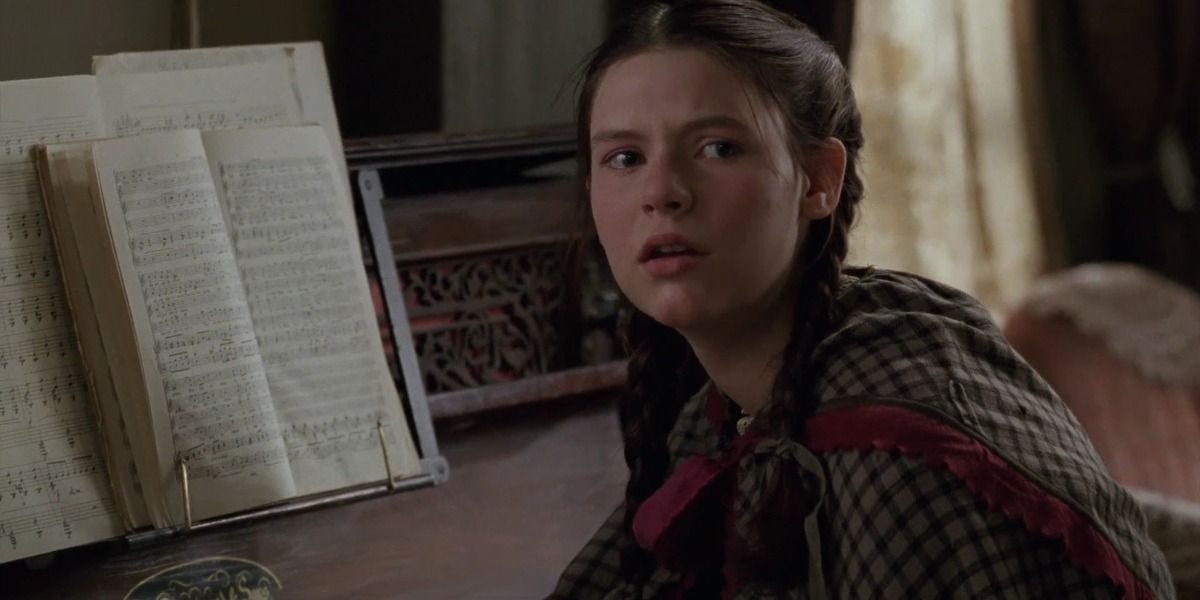
Not only does Beth reveal goodness around and within her sisters, but she also draws others towards beauty as well. Beth primarily accomplishes this through her love of music and playing the piano. In the evenings, the March family stand around the piano while Beth plays and they all sing songs together; the narrator says, “No one but Beth could get much music out of the old piano, but she had a way of softly touching the yellow keys and making a pleasant accompaniment to the simple songs they sang”.5 Through Beth’s gentleness and love of playing, she draws beautiful music out of the old piano like no one else can; she allows her family to see the loveliness that can come from something old and worn. Beth’s ability to point others to beauty is particularly evident when she accepts Laurie’s grandfather’s invitation to visit his house to play his nice, fancy piano. She comes to his house every day to practice, and she is unaware that Mr Laurence listens to her playing from his study. Her very presence in his house reminds him of his granddaughter who died tragically as a child, and her playing revitalises a home that was once a little too quiet. Beth’s playing softens the old man and helps him rediscover joy in the small things in life; this is clear when Mr Laurence gifts Beth his granddaughter’s piano to thank her for making him a pair of slippers. When Beth goes to Mr Laurence to thank him for his generous gift, she gives him an unexpected hug, and “all his crustiness vanished, and he just set her on his knee, and laid his wrinkled cheek against her rosy one, feeling as if he had got his own little granddaughter back again”.6 This exposure to beauty that Beth provides helps to heal Mr Laurence and allows him to cherish the memory of his granddaughter in a way that leads to generosity and joy.
Despite Beth’s ability to draw others towards the beautiful, she struggles to enjoy beauty for herself. When Beth receives the gift of the piano from Mr Laurence, she is overcome by both gratitude and shame. She goes pale and she buries her face in Jo’s apron when she first learns about this incredible gift; the narrator writes that she is “quite upset by her present”.7 She exclaims “I feel so queer! Oh, it is too lovely!”.8 Beth is very grateful and she “[touches] the beautiful black and white keys and [presses] the bright pedals”9 but thinks she is undeserving of it. However, just as Beth’s gift of music helps to heal Mr Laurence, his own gift of the piano helps to heal Beth in her own way too. This gift brings out a bolder, more determined side of her personality that she rarely exhibits. Instead of being too timid and afraid to thank Mr Laurence directly, Beth decides to visit him to express her gratitude. Not only does she start to thank Mr Laurence, but she even hugs him and gives him a kiss on the cheek.10 This reaction is entirely unprecedented for Beth; this gift of beauty that Mr Laurence gives her allows her to step out of herself for the first time and voice her feelings in a way that is bold and unapologetic. The narrator writes that “Beth ceased to fear him from that moment, and sat there talking to him as cozily as if she had known him all her life, for love casts out fear, and gratitude can conquer pride”.11 Through the inspiration of Mr Laurence’s beautiful gift, Beth paradoxically grows in the virtues of fortitude and humility, much to the amazement of those around her.
While Beth’s quiet demonstration of goodness and beauty is undoubtedly moving, the most impactful is her ability to reveal truth to her family. Beth’s primary display of truth occurs in her death, which is one of the most heartbreaking and inspiring moments in all of literature in my opinion. Beth often visits the Hummels, a family struggling with poverty whom the Marches befriend, and she falls ill after helping to care for Mrs Hummel’s gravely sick baby. When Beth returns home after her last visit at the Hummels’, she mournfully exclaims that the baby died of scarlet fever while she was holding him.12 Even though she knew it was likely that she would contract the same illness, Beth nevertheless repeatedly helped to look after the children out of the pure goodness of her heart. She expected nothing in return, and only wanted to help a family in need. Beth’s constant willingness to help reveals that true love is self-sacrificial, no matter the consequence.
She does contract the fever and after an acute period of suffering, Beth slowly improves. However, even years later, Beth struggles with the effects of the disease. Later on in the book, once Beth becomes aware that she is dying, her family witnesses a noticeable and interesting change in her demeanour. She seems happy and at peace after having been so sad and despairing just months before. In an incredibly touching scene with Jo, Beth explains that she’s accepted her death, saying, “‘I’ve known it for a good while, dear, and now I’m used to it, it isn’t hard to think of or to bear. Try to see it so and don’t be troubled about me, because it’s best, indeed it is”.13 She then reassures Jo, saying that in the time they have left together, they will enjoy each other’s company and share in life’s joys while they still can.14 When Beth does pass away, in her final moments she says to Jo humbly, “‘I’m not so good as you make me, but I have tried to do right. And now, when it’s too late to even begin to do better, it’s such a comfort to know that someone loves me so much, and feels as if I’d helped them”.15 This deathbed quote from Beth reveals that her whole life has been devoted to the truth of self-sacrificial love. In her desire to do the right thing at all times, she placed others before herself and tried to help people as much as she could, even if she felt like she fell short. Throughout the book, but especially at this moment, Beth reveals the truth that a life worth living is one dedicated to loving and serving others without counting the cost.
Though most readers might not realise it, Little Women in my opinion is a deeply theological book precisely because of Beth’s influence throughout the story. Despite her flaws, her constant devotion to virtue and service reveal goodness, beauty, and truth laced throughout everyday life. Ultimately, Beth’s example shows that one can lead an ordinary life and still have an extraordinary impact on others.
Little Women, pg. 1.
Pg. 1.
Pg. 15.
Pg. 23.
Pg. 20.
Pg. 82.
Pg. 80.
Pg. 80.
Pg. 81.
Pg. 82.
Pg. 82.
Pg. 216-17.
Good Wives, pg. 164.
Pg. 165.
Pg. 216.